
Learning to read an ingredient list isn't about memorizing complicated chemical names. It boils down to one simple, powerful principle: ingredients are listed by weight, from most to least. Once you get that, everything else clicks into place. This single rule gives you the power to see past the flashy marketing and understand what a product is truly made of.
Why This Is a Skill You Can't Afford to Skip
Ever picked up a box of "healthy" granola bars, flipped it over, and saw sugar listed as the first or second ingredient? That's the moment of truth. Knowing how to read that list isn’t just for people with severe allergies; it’s a fundamental skill for anyone who wants to take charge of what they bring into their home.
Let's be honest, the front of the package is prime real estate for marketing. It's designed to sell you a story with appealing words like "all-natural," "multigrain," or "made with real fruit." The back of the package is where the facts live.
People Are Catching On
If you're starting to pay more attention to labels, you're in good company. Consumer demand for real, honest information is growing fast. In the U.S., checking the Nutrition Facts panel has become a normal part of shopping for most people.
Recent data shows that nearly 80% of American adults reported using the panel between 2017 and March 2020. That's a huge leap from just 62% in the mid-2000s. If you're curious, you can dig into the numbers yourself with the USDA's findings on nutrition label use. This isn't just a trend; it's a massive shift toward consumers wanting to know exactly what they're buying.
Think of it this way: learning to read an ingredient list is like getting a backstage pass. You get to see what's really going on behind the curtain of slick advertising, giving you total control over what you and your family consume.
The Real-World Payoff
Getting good at this pays off immediately and for years to come, and the benefits go way beyond just food. You're building a foundation for a healthier life, one smart choice at a time.
Here's what you gain:
- Ditching Harmful Chemicals: You'll become a pro at spotting and sidestepping endocrine-disrupting chemicals (EDCs), artificial colors, and weird preservatives you'd rather avoid.
- Managing Allergies and Sensitivities: For anyone navigating allergies to things like milk, soy, or nuts, this skill is absolutely essential for keeping your family safe.
- Seeing Through "Health Halos": You'll instantly recognize when a "gluten-free" snack is really just a block of refined starches and sugar, or when "low-fat" actually means "loaded with artificial junk."
- Actually Reaching Your Goals: Whether you want to cut back on sugar, eat more fiber, or simply stick to whole foods, the ingredient list becomes your most trusted roadmap.
My goal is to walk you through the practical steps to make this second nature. It’s easier than you think.
Alright, let's get into the nitty-gritty of reading an ingredient list. This is where the truth about a product lives, far from the flashy marketing on the front of the package.
The single most important thing to understand is that ingredients are listed by weight. The heaviest, most abundant ingredient comes first, followed by the next heaviest, all the way down to the lightest. Once this clicks, you'll never look at a food label the same way again.
Think about it. You pick up a "Healthy Fruit & Nut Bar." But when you flip it over, the first three ingredients are "Oats," "Brown Rice Syrup," and "Cane Sugar." You know instantly this isn't what it claims to be. It's a sugar-and-grain bar, with a few fruits and nuts thrown in for show. This simple rule is your best defense against misleading claims.
Decoding What’s Inside the Parentheses
Ever notice an ingredient that has its own little list in parentheses? That’s what we call a compound ingredient—basically, an ingredient that’s made up of other ingredients.
For example, a label might list ‘dark chocolate.’ But instead of leaving it at that, regulations require the manufacturer to show you what’s in that chocolate. You'll see something like this: "dark chocolate (cocoa mass, sugar, soy lecithin)." This transparency is your friend. It stops companies from hiding unwanted sugars, oils, or additives inside what looks like a single, simple ingredient.
This visual breakdown really helps drive the point home.
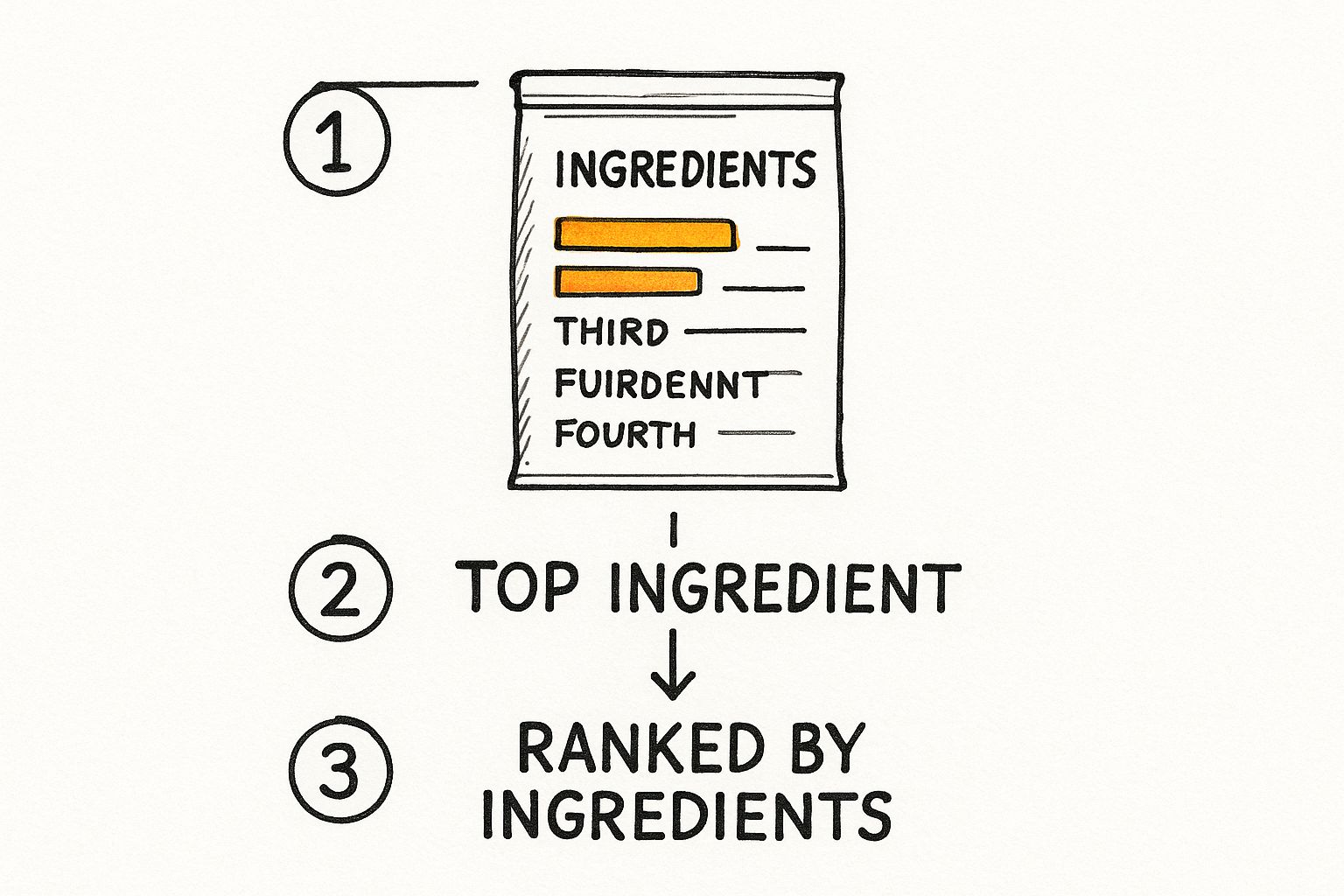
As you can see, the first few items on any list are doing all the heavy lifting. They make up the bulk of what you’re about to eat, so that’s where your attention should go first.
Why Are These Labels So Hard to Read?
If you feel like you need a science degree to understand an ingredient list, you’re not alone. And it’s often intentional. The language can be overly technical and confusing by design.
A 2022 study revealed that over 84% of ingredient lists are written at a 10th-grade reading level or higher. For a bit of perspective, complex medical consent forms are usually written at an 8th-grade level to ensure people can actually understand them.
This complexity is a huge barrier. You might be carefully scanning for sugar but completely miss "dextrose" or "barley malt." The same goes for chemicals that can mess with your hormones. If you're trying to cut out certain additives, you might find our guide on what are endocrine disruptors helpful—they are notorious for hiding in plain sight.
Getting comfortable with these labels just takes a little practice. Let's start with one of the most common tricks in the book.
Unmasking Hidden Sugars
One of the oldest tricks for making a product seem healthier is to hide the sugar. How? By using several different types of it.
Since ingredients are listed by weight, this clever tactic breaks up one big, alarming ingredient ("sugar") into three or four smaller ones. This pushes each type of sugar further down the list, creating a healthier-looking label.
You might see a list that starts like this: "Whole grain oats, brown rice syrup, cane juice, barley malt, dextrose…" If you were to group all those sweeteners together as "sugar," it would almost certainly be the #1 ingredient.
To help you spot these, I've put together a quick cheat sheet.
Common Hidden Sugars and Their Names
Manufacturers have dozens of names for sugar. Getting familiar with the most common ones will help you quickly identify just how much is really in your food.
| Syrup-Based Names | Names Ending in '-ose' | Other Common Names |
|---|---|---|
| Corn syrup | Dextrose | Barley malt |
| High-fructose corn syrup | Fructose | Cane juice crystals |
| Brown rice syrup | Glucose | Cane sugar |
| Maple syrup | Lactose | Coconut sugar |
| Agave nectar | Maltose | Evaporated cane juice |
| Honey | Sucrose | Fruit juice concentrate |
Keep an eye out for these terms. Spotting two, three, or even four of them on a single label is a major red flag that the product is packed with more sugar than you think.
Spotting Unwanted Additives and Preservatives
Alright, so you’ve gotten the hang of spotting hidden sugars. What's next? Now we turn our attention to the other unwanted guests that frequently crash the party in our food: additives, preservatives, and artificial colors.
Companies add these ingredients to make products last longer on the shelf or to give them a vibrant, "healthy" look they wouldn't otherwise have. The problem is, they do absolutely nothing for your health.
Learning to read labels for these chemicals is a game-changer. They’re often buried in long, confusing lists with names that sound like they belong in a science lab. Don't worry, you don’t need a chemistry degree. The goal is simply to recognize the most common red flags so you can make a quick, confident decision in the grocery aisle.
For example, you might see "enriched flour" on a label, only to be followed by a list of artificial colors. That's a huge tell. It means the original nutrients were stripped away, and then chemicals were added back in to make it look appealing again.
Common Additives to Watch For
Let’s focus on a few key players you’ll see over and over. Trying to memorize a massive list is just overwhelming and, frankly, not necessary. If you can get familiar with these common culprits, you'll be able to spot a highly processed product from a mile away.
Here are some specific examples you’ll run into all the time:
- Artificial Colors: These pop up as names like Red 40, Yellow 5, and Blue 1. You'll find them in the obvious stuff like candy and sports drinks, but they also sneak into foods you might think are healthy, like yogurt and cereal.
- Common Preservatives: Keep an eye out for sodium benzoate, potassium sorbate, BHT (butylated hydroxytoluene), and TBHQ (tertiary butylhydroquinone). These are used to keep things like crackers, cereals, and processed meats from spoiling.
Seeing any of these on a label is a dead giveaway that you're holding an ultra-processed food. Real, whole foods don't need a dash of Red 40 to look appetizing or a sprinkle of BHT to stay fresh.
Developing this skill is incredibly empowering. It helps you sidestep foods that just don’t fit into a clean, low-toxin lifestyle. This is the same kind of conscious-choice mindset we talk about in our guide on how to avoid pesticides in your food, where small changes dramatically cut down your exposure to unwanted chemicals.
The Mystery of "Natural Flavors"
Of all the confusing terms on an ingredient list, "natural flavors" might be the most deceptive. It sounds perfectly fine, even healthy. But the reality is quite different.
The term is so loosely regulated that it's practically meaningless. While the flavor's origin has to be a plant or animal, what you actually get is often a complex chemical cocktail whipped up in a lab. These proprietary formulas can contain dozens of incidental additives—solvents, emulsifiers, preservatives—that a company doesn't have to list on the label.
So, when you see "natural flavors" high up on an ingredients list without a specific source (like "natural vanilla flavor"), it's usually a hallmark of a highly processed food. It’s a trick to create an intensely crave-able taste that real, whole ingredients just can't match.
Ultimately, making better choices is all about pattern recognition. A short list of ingredients you can actually pronounce and picture in your head? That’s a fantastic sign. A long, rambling list full of artificial colors, multiple preservatives, and the vague "natural flavors"? That's your cue to put it back on the shelf and walk away.
Seeing Past Front-of-Package Marketing Claims
The front of the box is designed to sell you a story. The back of the box is where you’ll find the truth. Once you get the hang of reading ingredient labels, you’ll start to notice the massive gap between the shiny marketing claims on the front and the reality listed on the back.
Clever packaging uses all the right buzzwords to create a "health halo" around a product, making you feel great about putting it in your cart. But words like "all-natural," "multigrain," and "made with real fruit" sound fantastic but are often legally meaningless or just plain misleading.
For example, a "multigrain" cracker might seem wonderfully wholesome. But flip it over, and you could easily find the first ingredient is refined wheat flour, with just a sprinkle of other grains added to justify the claim. In the same way, a cookie labeled "gluten-free" can still be loaded with processed starches, refined sugars, and inflammatory oils.
Decoding Common Marketing Lingo
Think of the claims on the front of a package as a language you need to translate. Manufacturers are masters at using words that trigger a positive response, but these terms often have very loose, flexible definitions.
Let's break down a few common ones I see all the time:
- "Made with Real Fruit": This is a classic. A product can flash this claim even if it only contains a tiny drop of fruit concentrate, while the main sweeteners are actually high-fructose corn syrup and cane sugar.
- "All-Natural": This is probably one of the most unregulated terms out there. It generally means nothing artificial or synthetic has been added, but the product itself can still be heavily processed and far from healthy.
- "No Sugar Added": This sounds promising, but it doesn't mean the product is low in sugar. It could be sweetened with huge amounts of fruit juice concentrate—which, newsflash, is still a form of sugar.
The ingredient list doesn't lie. It’s your most reliable tool for cutting through the marketing noise. It forces you to ignore the pretty picture on the front and focus on what you're actually about to eat.
Why Labeling Policies Matter
How much you can get from a label often comes down to how clear and honest the company is required to be. It’s fascinating to see how policy makes a real difference.
A revealing 2023 international study looked at kids and teens across six different countries. In places with mandatory front-of-pack warning labels, like Chile and Mexico, awareness of unhealthy ingredients was incredibly high—92% and 85%, respectively.
But in countries with only voluntary labeling, like Australia and the UK, that awareness dropped significantly. You can dig into the specifics of these labeling findings on BioMed Central to see the full picture.
This really shows that clear, enforced rules—not just marketing spin—are what truly empower us. Until those rules become universal, becoming your own best advocate is the only way. So, next time you're shopping, try this: pick up a product with a bold health claim and immediately flip it over. Compare the story on the front with the facts on the back. This simple habit will quickly turn you into a smarter shopper who can't be fooled by clever packaging.
Turning Knowledge into Smart Shopping Habits
Alright, you've learned how to read an ingredient label. That's a huge step! But knowing what to look for is only half the battle—the real change happens when you start putting that knowledge to work at the grocery store.
The goal here isn’t to trigger a stressful, all-out pantry purge. That’s overwhelming and rarely sticks. Instead, we’re going to focus on building simple, sustainable habits that become second nature over time.
A great place to start is with what I call the Five-Ingredient Rule. When you pick up a packaged food, just take a quick peek at the ingredient list. If it has more than five ingredients, it's a sign to pause and investigate a little closer. This isn't a hard-and-fast law, but it’s an incredibly effective shortcut for weeding out highly processed products and steering you toward simpler, more whole-food options.
You’ll quickly notice that following this rule is much easier if you stick to the perimeter of the grocery store. This is where the fresh, whole foods tend to live—the produce, the butcher counter, the dairy case. The middle aisles? That's typically where you'll find a maze of processed foods with ingredient lists a mile long.
Start with Small, Sustainable Swaps
Trying to change everything all at once is a surefire way to get frustrated and quit. A much smarter—and more successful—approach is to make small, gradual swaps. Don't try to overhaul your entire kitchen in a single weekend. Just pick one thing to focus on for your next shopping trip.
Here's what that might look like in practice:
- Breakfast Cereal: Is there a family-favorite brand you always buy? Next time, just compare its first three ingredients to a couple of other options. See if you can find one with less sugar and no artificial colors.
- Snack Bars: So many of these are just candy bars with better marketing. Challenge yourself to find one where sugar isn't in the top three ingredients and you can actually pronounce everything on the list.
- Salad Dressing: These are notorious for hiding sugar, inflammatory oils, and all sorts of preservatives. Look for brands that lead with extra virgin olive oil and use simple spices you recognize.
This one-category-at-a-time method feels manageable and keeps you from getting overwhelmed. It’s all about making steady progress, not achieving instant perfection. Over a few months, these small wins compound into a massive, positive shift in the quality of what you bring home.
The real victory isn't about perfectly avoiding every single "bad" ingredient. It's about consistently choosing products with shorter, cleaner, and more recognizable ingredient lists. That habit is your best defense against unwanted chemicals and clever marketing.
Create Your "Non-Negotiable" List
As you get more confident reading labels, you'll naturally start to develop a personal list of "non-negotiables." These are the ingredients you decide are simply not welcome in your home, period.
This list might include specific artificial colors like Red 40, preservatives like BHT, or hidden sources of endocrine-disrupting chemicals. As your knowledge deepens, you might want to learn more about the specific effects of endocrine disruptors to help you decide what to add to your list.
Having your own set of standards makes shopping so much faster. You can scan a label for your deal-breakers and make a snap decision. This isn't about being rigid for the sake of it; it's about being intentional. Your home is your sanctuary, and carefully choosing what comes through the door is one of the most powerful ways to protect your family's health for the long haul.
Answering Your Top Label Reading Questions
Once you start looking closer at ingredient labels, you’ll naturally have questions. It’s a new skill, and like anything else, there’s a bit of a learning curve. Let’s tackle some of the most common things that trip people up so you can feel more confident in the grocery aisle.
The first thing most people notice is just how long some ingredient lists are. A long, complicated list is often your first red flag. It’s a dead giveaway that a food is highly processed and a long way from its natural state. After all, an apple doesn't need a list of stabilizers and additives.
Another one I get asked about all the time is "natural flavors." It sounds innocent, right? But this is one of the most misleading terms on any label. That one phrase can hide a complex cocktail of chemicals engineered to make something taste a certain way, without adding any real nutritional substance.
What About "May Contain" Warnings?
You've definitely seen these before: "May contain traces of nuts" or "Processed in a facility that also handles soy." These are what we call precautionary allergen labels. The tricky part is that they're completely voluntary and unregulated. That means one company’s warning isn't necessarily the same as another's.
If you or a family member has a severe allergy, these warnings are a clear signal to avoid the product entirely. But if your goal is simply cleaner eating, these statements mostly point to potential cross-contamination and are less of a concern than the ingredients that are supposed to be in there.
Think of it this way: The main ingredient list is what the company intentionally put in the product. The precautionary warning is what might have accidentally slipped in. Always focus on the intentional ingredients first.
Are "Dairy-Free" and "Non-Dairy" the Same?
This is a great question, and the answer is a surprising "no." These terms can be incredibly deceptive, especially for anyone who needs to avoid milk proteins for health reasons.
- Dairy-Free: This term isn’t officially regulated, but it’s the one most companies use to signal that a product has zero milk or milk-derived ingredients. It's generally the safer bet.
- Non-Dairy: Now this is where it gets tricky. A product labeled "non-dairy" can legally contain casein, which is a milk protein. You see this all the time in coffee creamers and whipped toppings that list sodium caseinate on the back.
The takeaway here is simple but crucial: always trust the ingredient list over the claims on the front of the box. Never assume "non-dairy" means a product is actually free from all parts of milk. Taking a few seconds to verify the ingredients is the only way to know for sure.
At Esoterica, we believe creating a healthier home shouldn't be so confusing. We're here to provide clear, research-backed guidance to help you confidently reduce your family's exposure to harmful chemicals. Start your journey to a low-tox life with our trusted resources at https://shopesoterica.co.

