
That daily routine of lotion, lipstick, and foundation? It might be adding more to your life than just a touch of glam. Many of the beauty products we reach for every day contain chemicals linked to some serious health concerns. But this isn't about fear—it's about empowerment. This guide is your roadmap to navigating the beauty aisle with confidence, so you can find safer, healthier options.
The Unseen Dangers in Your Daily Routine
Think about how you start your day. A splash of toner, a layer of serum, a swipe of foundation, and a bit of mascara. Each product is a small step in a ritual meant to make you look and feel great. But what if those pretty bottles and tubes held a few secrets?
The surprising truth is that the beauty industry has far fewer regulations than most people think. This lack of oversight means that questionable ingredients can easily find their way into the very products we trust and use on our skin every single day.
And this isn't a small problem. We're talking about a widespread issue. One recent review uncovered about 88 chemicals in over 73,000 cosmetic products that are known toxins with potential health impacts. Some of these substances, like heavy metals such as arsenic and lead, are sometimes even added on purpose to get a certain look or effect. You can explore the full study about these cosmetic toxins to dig deeper into the findings.
From Worry to Wise Choices
The point here isn't to make you panic and toss everything in your bathroom cabinet. It's about helping you shift from being a passive consumer to an informed advocate for your own well-being. The first step is simply understanding the most common toxic chemicals in cosmetics—what they are, why they're in there, and how you can spot them.
Think of it like learning to read a nutrition label on your food. At first, that long list of ingredients can feel overwhelming. But once you know what to look for, you can quickly tell what’s good for you and what isn't. The exact same idea applies to your beauty products.
This guide will give you that knowledge. We’re going to move past the scary headlines and give you a clear, practical plan. You'll learn how to decipher ingredient lists, recognize the biggest red flags, and find trustworthy alternatives that actually support your health. By the end, you'll feel completely confident choosing products that are both safe and effective for you and your family.
Unmasking the Most Common Toxic Ingredients
Trying to decipher a cosmetic ingredient list can feel like you've been handed a chemistry textbook in a foreign language. The back of every bottle is filled with long, complicated names, making it nearly impossible to feel confident about what you’re putting on your skin. But learning to spot the usual suspects—the most common toxic chemicals in cosmetics—is the first real step toward making safer choices.
Think of this as your personal field guide. We won't just list the ingredients; we'll get into why companies even use them. Knowing the "why" is what turns confusion into real, practical knowledge.
This infographic breaks down some of the most common culprits you might find lurking in your own bathroom cabinet.
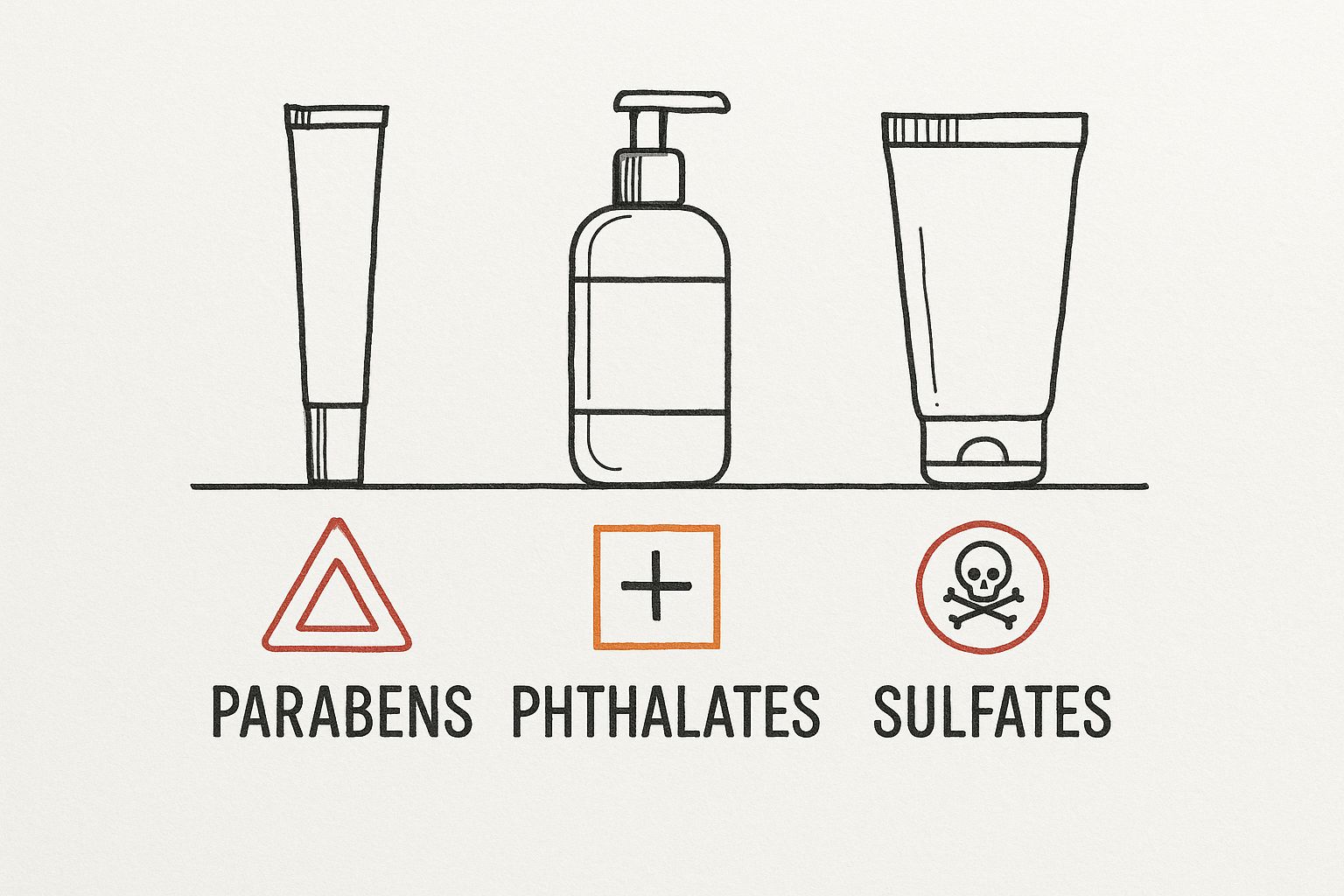
As you can see, these chemicals are often hiding in plain sight in the products we use every single day, from our shampoo to our favorite foundation.
Parabens: The Problematic Preservatives
Parabens are a group of synthetic chemicals that act as preservatives. Their job is pretty straightforward: they stop bacteria, mold, and yeast from growing in your lotions, shampoos, and makeup, which gives them a much longer shelf life.
You can spot them on an ingredient list by looking for anything ending in "-paraben," like methylparaben, propylparaben, or butylparaben.
So, what's the big deal? The main concern with parabens is their uncanny ability to mimic the hormone estrogen in our bodies.
Think of your body's hormone system as a finely tuned radio, perfectly picking up the signals it needs to function. Parabens are like static interference, scrambling those signals and potentially throwing your natural hormonal balance completely out of whack.
Because of this hormonal mimicry, parabens are classified as endocrine-disrupting chemicals (EDCs). If you want to get a better handle on how these substances work, our detailed guide explains https://shopesoterica.co/blog/what-are-endocrine-disruptors/ and the impact they can have.
Phthalates: The Hidden Softeners
Next up are phthalates (which you pronounce as THAL-ates). These chemicals are true multitaskers in the cosmetics world. They're used to make fragrances stick around longer and to make plastics, like the kind in nail polish, more flexible and less prone to chipping.
The really tricky thing about phthalates is that you often won't find them listed on the label. They can be legally hidden under the catch-all term "fragrance" or "parfum." This "fragrance loophole" means a company can pack dozens of chemicals into a product without having to disclose a single one.
Just like parabens, phthalates are also considered endocrine disruptors. Because they're in so many different products, they contribute significantly to our daily chemical exposure, making them a key ingredient to avoid if you're aiming for cleaner beauty.
Formaldehyde and Formaldehyde-Releasers
Yes, you read that right. The same chemical used in embalming can also be found in cosmetics. Sometimes, formaldehyde is used directly as a preservative, especially in things like nail polish and hair straightening treatments. More often, though, products contain ingredients that slowly release formaldehyde over time.
These are called formaldehyde-releasers, and they're much tougher to spot. Keep an eye out for these on the label:
- DMDM hydantoin
- Imidazolidinyl urea
- Diazolidinyl urea
- Quaternium-15
- Bronopol (2-bromo-2-nitropropane-1,3-diol)
These chemicals are added to kill microbes, but in doing so, they expose your skin to a continuous low dose of formaldehyde, which is a known carcinogen and a major skin allergen. You'll commonly find them in shampoos, body washes, and lotions.
Polyethylene Glycols (PEGs): The Penetration Enhancers
Polyethylene Glycols, or PEGs, are compounds derived from petroleum that are used to give cosmetics a smooth, creamy texture. They work as thickeners, solvents, and moisture-carriers, which is why you see them in everything from creamy foundations to hair conditioners.
With PEGs, the main worry isn't the compound itself, but the way it's made. The manufacturing process can create and leave behind nasty contaminants like ethylene oxide and 1,4-dioxane. Both of these byproducts have been linked to serious health problems, including cancer.
On top of that, PEGs also act as "penetration enhancers." This means they help other ingredients—including the potentially toxic ones—absorb much more deeply into your skin.
The sheer number of products containing these chemicals is startling. One study that looked at a wide range of skincare and makeup found that 58% of them contained at least one chemical of concern. Polyethylene glycols (PEGs) were the most common, showing up in 62.3% of the products tested. For more help identifying what to avoid, this list of 8 Skincare Ingredients to Avoid is a great resource.
How Daily Exposure Impacts Your Long-Term Health
It’s easy to shrug off the risks of a single pump of lotion or one swipe of lipstick. How much harm can a tiny amount really do? But the danger from toxic chemicals in cosmetics isn't about a one-time event. It’s a game of accumulation, where small, daily exposures from all your different products add up over months and years.
Think of it like a leaky faucet dripping into a bucket. A single drop seems like nothing. But leave it dripping long enough, and that bucket will eventually overflow. Your body is the bucket, and every product you use with harmful ingredients is another drop. This is how slow, steady exposure can lead to serious long-term health problems.
Our daily rituals—skincare, makeup, hair care—mean we're constantly layering these substances onto our largest organ: our skin. And what we put on our skin doesn't just sit there. Many ingredients are absorbed directly into the bloodstream, contributing to our overall toxic load.

The Endocrine Disruption Effect
One of the most troubling long-term impacts is endocrine disruption. Your endocrine system is the body’s master control panel, using hormones to regulate everything from your metabolism and mood to your reproductive cycles. It’s an incredibly delicate system built on balance.
Certain chemicals found in cosmetics, known as endocrine-disrupting chemicals (EDCs), can throw this whole system into chaos. They are master impersonators, with a molecular structure so similar to our natural hormones that they can fool our bodies.
Imagine your hormones are like specific keys designed to fit into special locks (receptors) throughout your body. Endocrine disruptors are like counterfeit keys. They can jam the locks, turn them at the wrong times, or even block the real keys from working at all. The result is total miscommunication.
This constant interference can lead to a host of issues over time, like hormonal imbalances, thyroid problems, and metabolic disorders. To get a better handle on this, we've created a guide that breaks down the specifics of endocrine disruptors in cosmetics and what they do.
Bioaccumulation and Lasting Consequences
Beyond just messing with your hormones, many of these chemicals are also persistent. This means your body struggles to break them down and get rid of them. Instead, they build up in your tissues—especially fat cells—over time. This process is called bioaccumulation.
This buildup is a major concern when it comes to reproductive health. A lifetime of exposure means these accumulated toxins can impact fertility, interfere with fetal development during pregnancy, and even be passed to infants through breast milk.
The consequences aren't always immediate or obvious. They often creep up slowly, showing up as chronic health problems years down the road. This is the long game of daily exposure—subtle, steady, and incredibly significant.
The Disproportionate Impact on Communities
It’s also critical to understand that the burden of this exposure isn't shared equally. Study after study shows that products marketed specifically to women of color often contain higher levels of the most harmful ingredients.
The numbers are shocking:
- Nearly 50% of beauty products marketed to Black women contain endocrine-disrupting chemicals.
- In contrast, only 7% of products marketed to white women have these same ingredients.
This disparity creates an unjust health burden on certain communities, turning the fight for safer cosmetics into an issue of social justice. Choosing cleaner products isn't just a wellness choice; it's a vital step toward health equity for everyone. By understanding the long-term impact, you can make choices today that protect your health for decades to come.
Become a Label Detective and Spot Hidden Toxins
https://www.youtube.com/embed/afHZxkFeXWQ
Have you ever flipped over a bottle of lotion or shampoo, only to be met with an ingredient list that reads like a foreign language? You're not alone. That wall of complicated chemical names can make anyone want to just give up and put the product in their cart.
This is your chance to go from a confused consumer to a confident label detective. With the right know-how, you can learn to spot the toxic chemicals that companies don't always want you to see, cutting through the marketing noise to make choices that are truly right for you.
The ‘Fragrance’ Loophole: A Major Red Flag
One of the most important—and deceptive—terms to watch for is "fragrance" or "parfum." It seems innocent enough, just a single word on a long list. But in reality, it's a Trojan horse.
Thanks to trade secret laws, companies aren't required to tell you what's actually in their signature scents. "Fragrance" can be a catch-all term for a cocktail of dozens, or even hundreds, of unlisted chemicals. These hidden ingredients often include phthalates (potent endocrine disruptors), synthetic musks, and other common allergens. When you see "fragrance" on a label, you're looking at a black box of unknowns.
Think of it this way: it’s like ordering the "mystery soup" at a restaurant. You have no idea what's in it—it could be delicious, or it could be full of things you're allergic to. "Fragrance" is the beauty industry's mystery soup. For real transparency, look for products scented only with essential oils that are clearly listed by name.
To truly become a label detective, a great starting point is understanding the ingredients in your shampoo and conditioner and learning what to avoid.
Learn to Spot Chemical Aliases
Problematic ingredients don't always use their most famous names. Much like a criminal using an alias, chemicals often appear on labels under different designations that make them harder to spot. Knowing these common disguises is a game-changer.
Formaldehyde is a classic example. You'll almost never see the word "formaldehyde" on a label because of its well-known link to cancer. Instead, manufacturers use preservatives called formaldehyde-releasers. These are chemicals designed to slowly break down over time, continuously releasing small amounts of formaldehyde gas into the product and, ultimately, onto your skin.
Keep an eye out for these common culprits:
- Quaternium-15
- DMDM hydantoin
- Imidazolidinyl urea
- Diazolidinyl urea
- Bronopol (2-bromo-2-nitropropane-1,3-diol)
If you spot any of these on a label for your lotion, shampoo, or liquid makeup, you've found a hidden source of formaldehyde.
Decoding Ingredient Labels and Common Red Flags
I get it—navigating the store aisle can be stressful, especially when you're in a hurry. The good news is you don't need a chemistry degree to make safer choices. By learning to recognize just a few of the most common red flags, you can significantly reduce your exposure to harmful chemicals.
This table is a handy cheat sheet to help you identify problematic ingredients that are often disguised under vague terms or different names.
| What to Look For | What It Might Hide | Found In |
|---|---|---|
| "Fragrance," "Parfum" | Phthalates, synthetic musks, allergens | Perfumes, lotions, hair products, air fresheners |
| Ingredients ending in "-paraben" | Endocrine-disrupting preservatives | Lotions, makeup, shampoos, conditioners |
| DMDM Hydantoin, Quaternium-15 | Formaldehyde (a known carcinogen) | Shampoos, body wash, lotions, liquid cosmetics |
| PEG, ingredients ending in "-eth" | Ethylene Oxide, 1,4-Dioxane (contaminants) | Creams, sunscreens, conditioners, foundations |
Learning to quickly scan for these terms is one of the most powerful habits you can build. While the world of cosmetic chemistry is complex, becoming a savvy label detective doesn't have to be.
For a deeper dive, check out our complete guide on how to read ingredient labels to build even more confidence. By focusing on these key offenders, you take back control and ensure the products you bring into your home truly support your health.
How to Build Your Safer Beauty Routine

Alright, so you’ve learned about the chemicals to watch out for. Now what? Moving from awareness to action can feel like a huge task, but I promise it doesn’t have to be. The secret isn't to toss everything in your bathroom cabinet at once.
Instead, think of it like a gentle renovation, not a total demolition. By making small, smart swaps over time, you can significantly lower your exposure to toxic chemicals in cosmetics without the overwhelm or the hit to your wallet.
Start With the Products That Cover the Most Ground
So, where do you begin? The most practical approach is to focus on the products that have the most contact with your skin. Anything you slather over large areas or leave on for hours gives you the biggest bang for your buck when you switch to a cleaner version.
I suggest prioritizing your swaps like this:
- Body Lotions and Oils: These are spread over your body's largest organ—your skin. A clean swap here makes an immediate, significant difference.
- Deodorant: You apply this every day to a very sensitive area right near your lymph nodes. This is a high-impact swap you won’t regret.
- Foundation and Face Moisturizer: Just like body lotion, these products sit on your delicate facial skin all day long.
- Lipstick and Lip Balm: You inevitably end up ingesting whatever you put on your lips, making this a critical product to clean up.
- Shampoos and Conditioners: These are a slightly lower priority since they get rinsed off, but they still cover your scalp and run down your entire body. As you shift away from harsh chemicals, looking into something like a natural hair cleanse can be a great way to reset and support healthier hair from the start.
By tackling your routine in this order, you’re making the most meaningful changes first. It’s all about working smarter, not harder.
Let Trusted Certifications Be Your Guide
The good news is you don't need a chemistry degree to shop safely. Several incredible third-party organizations do all the hard work for you, taking the guesswork out of finding genuinely clean products. When you're scanning the aisles, keep an eye out for their seals.
Think of these certifications as a background check for your beauty products. They confirm that a product not only avoids a long list of harmful chemicals but has also passed a strict review for transparency and overall safety.
Here are two of the most reliable certifications you can trust:
- EWG VERIFIED™: This seal from the Environmental Working Group is their gold standard. It means the product meets their toughest health criteria, avoids all of EWG's chemicals of concern, and practices full ingredient transparency.
- MADE SAFE®: This is one of the most rigorous certifications out there. If a product has the MADE SAFE® seal, it has been screened for over 6,500 known harmful chemicals, ensuring it’s free from ingredients linked to harming human health or our ecosystems.
Spotting these logos is a fantastic shortcut that gives you instant confidence in what you’re buying.
Embrace the Power of Simplicity
Building a safer routine doesn't always mean buying a specially formulated "clean" product. Sometimes, the best move is to go back to basics. Single-ingredient powerhouses can work wonders and are naturally free from the fillers, preservatives, and fragrances you're trying to avoid.
Consider making these incredibly simple and effective swaps:
- Jojoba Oil: Its molecular structure is strikingly similar to our skin's own oils, making it a perfect moisturizer and makeup remover.
- Shea Butter: Raw shea butter is packed with vitamins and fatty acids. It’s a wonderfully rich and nourishing body cream all on its own.
- Coconut Oil: This makes a fantastic body moisturizer. It’s also great for oil pulling, a simple practice to boost your oral health.
- Witch Hazel: Use this as a natural astringent to replace a conventional facial toner.
By combining these strategies—making smart swaps, relying on trusted certifications, and embracing simple ingredients—you can create a beauty routine that is both effective and genuinely good for you. It's about taking back control, one small step at a time.
The Movement for Safer Cosmetics and Why It Matters
The conversation around toxic chemicals in beauty products isn't just some new trend. It's a real public health movement, built over decades by researchers, advocates, and everyday people who started asking tough questions. Understanding where this all started helps you see just how much power you have when you're standing in the beauty aisle.
The "safe cosmetics" movement really caught fire in the early 2000s. It went from a quiet whisper in niche communities to a full-blown mainstream conversation. A huge turning point was a 2002 investigation by a group of public health and environmental advocates who were worried about phthalates.
They tested 72 popular, big-name beauty products, and what they found was shocking. The results showed that nearly three-quarters—almost 75%—of the products contained these hormone-disrupting chemicals, and most of them didn't even list it on the label. This one study was a massive wake-up call, sparking the creation of the Campaign for Safe Cosmetics and lighting a fire under a nationwide push for transparency. You can still read the original report on cosmetic safety that started it all.
How Your Choices Started a Revolution
This kind of research changed everything by putting solid evidence directly into the hands of consumers. For the first time, people had proof that the products they used and trusted every day could be hiding harmful ingredients. It completely shifted the way we think about shopping for cosmetics.
People started demanding to know what was in their products, and their collective voice, amplified by social media and advocacy groups, became a force that brands couldn't ignore. Companies that refused to be transparent started losing customers, and fast.
This wave of consumer pressure is the single biggest reason the industry is changing. When enough of us "vote" with our dollars, brands have no choice but to listen. They're pushed to reformulate products, get rid of questionable chemicals, and open up about where their ingredients come from. Every time you opt for a cleaner product or ask a brand a pointed question on social media, you're contributing to this powerful movement.
What This All Means for You Today
This ongoing push means you have more power and more options than ever before. The "clean beauty" explosion isn't just clever marketing; it's the industry's direct response to years of you and millions of others demanding better, safer products.
Now, you can find brands that proudly display their full ingredient lists and seek out third-party certifications that give you peace of mind. Your awareness and your choices are sending a loud and clear message to the entire beauty industry: we won't compromise on safety. You are the reason that healthier products are slowly but surely becoming the new normal.
Your Questions on Cosmetic Safety, Answered
Once you start looking more closely at what's in your everyday products, a lot of questions tend to pop up. It's completely normal. You might wonder if you can trust the claims on the front of the bottle or how a potentially harmful product could even end up on a store shelf. Let’s clear up a few of the most common questions people have when they begin their clean beauty journey.
Are "Natural" or "Organic" Products Automatically Safe?
In a word, no. It’s frustrating, but terms like "natural" and "organic" can be incredibly misleading because they aren't strictly regulated in the cosmetics industry. A product can be labeled "natural" and still contain synthetic preservatives or those mystery "fragrance" mixtures.
"Organic" carries a little more weight, but a product can use the term even if only a small percentage of its ingredients are actually certified organic. The rest of the formula could be anything. This is why you have to become a label-turner. Ignore the marketing hype on the front and go straight to the ingredient list on the back. That, along with trusted certifications, is the only real way to know what you’re getting.
If It’s Sold in a Big Store, Doesn't That Mean It's Safe?
You'd think so, but unfortunately, that's not the case. In the United States and many other countries, the cosmetics industry is largely self-policing. Government agencies have surprisingly little power to require safety testing before a product hits the market or to pull products that are found to cause harm.
The fact that a product is on a major retail shelf is a reflection of a brand's distribution network, not a guarantee of its long-term safety. This reality is precisely why consumer education and proactive label-reading are so critical for protecting your health.
This regulatory gap puts the burden of safety right back on us, the consumers. It’s up to us to stay informed and be vigilant.
How Can I Find Trustworthy Information on Ingredient Safety?
The good news is, you don't have to be a chemist to figure this out. Several fantastic non-profit groups have already done the hard work for you. They dig into the science and compile easy-to-use databases so you can check a product's safety in seconds.
Here are a few of the best tools out there:
- The Environmental Working Group's (EWG) Skin Deep® Database: An incredible resource. You can look up thousands of products or individual ingredients and get a safety rating based on the latest scientific research.
- The Campaign for Safe Cosmetics: This group is all about advocacy and education. They offer deep-dive reports and fact sheets that explain the issues and keep you updated on the fight for safer products.
- MADE SAFE®: This certification is one of the most rigorous. If you see their seal, it means a product is free from a massive list of known toxic chemicals. Their website also has lists of certified products to make shopping simple.
Leaning on these resources is the best way to cut through the marketing noise and feel truly confident about the products you bring into your home.
At Esoterica, we believe knowledge is power, especially when it comes to your health. We’re here to give you trusted, research-based information and practical guidance to help you reduce your exposure to harmful chemicals and create a safer environment, one simple step at a time. To continue your journey, explore our resources at https://shopesoterica.co.

